

Most of the pine floors we sand across Melbourne’s eastern suburbs have been wearing the same coating for decades, and this Wantirna home was a textbook case. The radiata pine boards running through most of the house were still sound underfoot, but the finish sitting on top of them had well and truly given up. Deep orange where it was still intact, grey and bare through the doorways and traffic paths, and marked with paint splatter and scuffs that no amount of cleaning was ever going to shift. We sanded the lot back to raw timber and finished it with a Bona water based matt coating.
What the Floors Looked Like Before
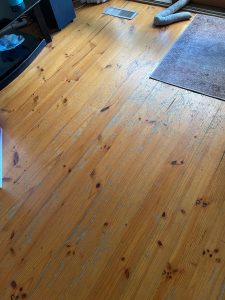
The original coating had ambered heavily over the years, which is what gives an old pine floor that strong orange cast. That colour shift is not the timber itself, it is the finish sitting over the top of it, and it is one of the main reasons homeowners assume an old pine floor is beyond saving when it usually is not.
Underneath the orange, the wear told a clear story. Traffic lanes between the living area and the rear doors had gone grey and chalky where the coating had worn straight through and left the bare timber exposed to air and foot traffic. There were patches of grey residue and paint splatter through the middle of the room, scratches running with the grain, and heavier damage where furniture had been dragged. Around the heating vents and the door thresholds the finish had broken down completely.
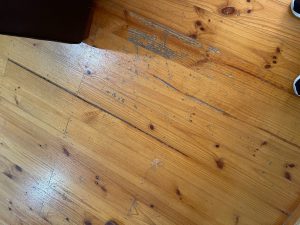
None of this is unusual for a floor of this age, and none of it ruled out a sand and coat. Once the old finish comes off, what is left is the timber itself, and in this case the boards had plenty of life in them.
Why Radiata Pine Is a Different Job to Hardwood
Radiata pine is considerably softer than the Australian hardwoods we more commonly sand, such as spotted gum or blackbutt. That difference changes how the job needs to be approached from the first pass of the machine.
A drum sander that sits a fraction too long in one spot on hardwood might leave a faint mark. On pine it will leave a dish you can feel with your foot. The timber cuts quickly and unevenly, because the soft early wood between the growth rings sands away faster than the harder late wood, which is what can leave a washboard texture across the boards if the operator is not reading the floor as they go.
Knots are the other complication, and this floor had plenty of them. Pine knots are dense, resinous and much harder than the surrounding board, so they sit proud of the surface if the floor is sanded too lightly and burn or char if it is worked too hard. Getting them flush without flattening the grain around them is the part that takes experience rather than equipment.
Old nail heads also need attention. On a floor this age, fixings work their way up over time, and every one of them has to be punched below the surface before sanding starts. Miss one and it will tear the abrasive belt and leave a gouge running the length of the room.
Sanding Back Decades of Coating
We worked through the house room by room. The first cut removed the old ambered coating and levelled out the board to board height variation that had developed over the years. From there we stepped through progressively finer grits, each one removing the scratch pattern left by the last, until the surface was smooth and consistent enough to take a coating evenly.
The edges are where a lot of the time goes on a job like this. An edging machine handles the perimeter against the skirtings, but the tight spots still need a careful hand: around the floor vents, in and out of the doorways, along the hearth of the wood heater, and into the corners of the smaller rooms. These are the areas where a rushed sand shows up immediately once the light hits the floor.
Dust extraction runs throughout, and the floor is vacuumed and tacked thoroughly before any finish goes down. On a whole house job with the occupants still living in the property, keeping dust under control matters as much as the finish itself. You can see more examples of sanding work across Melbourne’s eastern suburbs on our Our Work page.
Why We Finished With a Bona Water Based Matt Coating
As certified Bona contractors, their water based system is what we reach for on the majority of residential sanding jobs, and on a pine floor in particular it solves a few problems at once.
- It keeps the timber pale: the orange cast on the original floor came from an older solvent based finish ambering with age. A water based coating stays clear rather than yellowing, so the pine holds the soft honey tone it has when freshly sanded instead of drifting back towards orange in a few years.
- The grain does the talking: a matt sheen sits close to how raw timber looks, which lets the knots, grain and natural colour variation in the pine read clearly rather than being hidden behind a glossy reflective surface.
- Low odour and a quicker turnaround: water based coatings carry a fraction of the smell of traditional solvent based products and dry faster between coats. On a job covering most of a house, that is the difference between the owners being displaced for a week and being back in their rooms far sooner.
- Durability across the whole floor: this coating had to hold up through living areas, hallways and bedrooms, including the traffic lanes that destroyed the previous finish. A quality water based matt system is built for that daily wear while staying straightforward to maintain.
If you are still weighing up finishes for your own floor, our timber sealing and coating page runs through how matt, satin and gloss each behave in a home. We recently used the same Bona water based matt system on a brand new Spotted Gum floor in Portsea, which shows how differently the finish reads on a hardwood compared with pine.
The Finished Floor
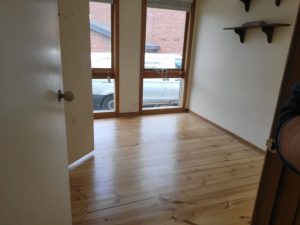
The change in the house was immediate. Gone is the orange, and in its place is a soft, pale honey floor with the grain and knots reading clearly across every board. The traffic lanes have disappeared entirely, the boards run cleanly past the vents and out through the doorways without a break in the line, and the matt finish gives the rooms a calm, low glare surface rather than bouncing light straight back at you.
Because the work covered most of the house, the floor now reads as one continuous surface from the living areas through to the bedrooms, which is something a room by room approach never quite achieves. It is also worth noting how much brighter the smaller rooms feel with a pale floor underfoot instead of a dark, worn one.
For homeowners who would rather change the colour of their boards than keep the natural timber tone, staining is an option worth considering at the same time, and our timber staining and liming page covers what is possible.
Thinking About Sanding Your Own Pine Floors?
If you have pine boards under carpet, or an existing floor that has gone orange and worn through in the traffic areas, there is a good chance it can be brought back rather than replaced. The only way to know for certain is to have someone look at the boards, check their thickness and condition, and tell you honestly what a sand and coat will achieve.
Croydon Floor Services has been sanding, sealing and installing timber floors across Melbourne and the eastern suburbs since 1982, and we cover Wantirna and the surrounding areas regularly. Get in touch through our Contact Us page for a free quote on your floor.
- By: Croydon Floors
- Category: Timber Sealing & Coating
- 0 comment
Leave a Reply